Case Digestor Topnotcher Metrics Guide
This guide explains the logic and pedagogical significance behind the Readiness Score and Confidence-Action Gaps implemented in the LEGALBAI Hub.
1. The Readiness Score
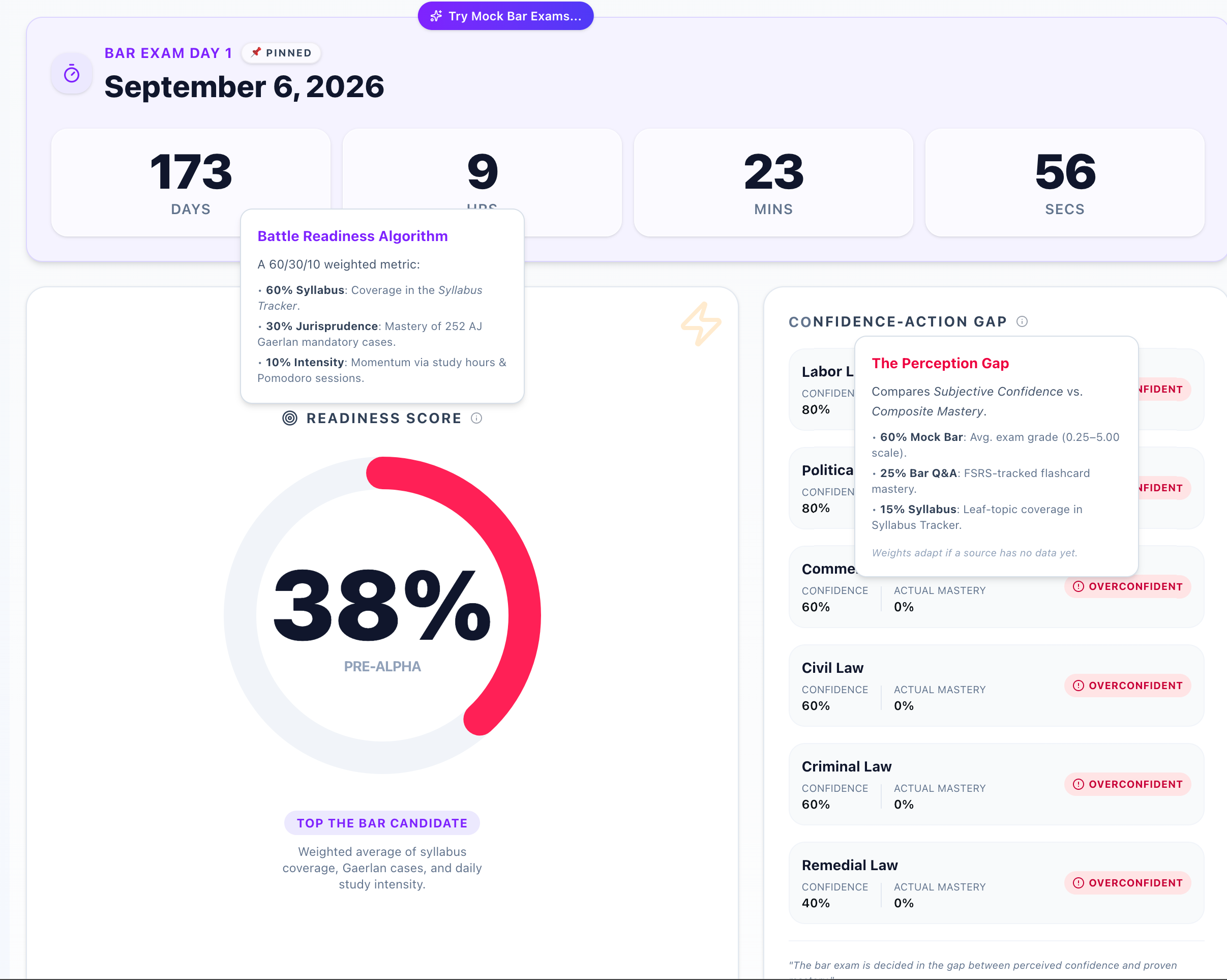
The Readiness Score is a weighted, data-driven metric that quantifies a candidate's overall "battle readiness" for the Bar Exam. It moves away from simple completion percentages by incorporating depth and intensity.
Calculation Algorithm
The score is calculated using a 60/30/10 weighting strategy:
| Weight | Metric | Description |
|---|---|---|
| 60% | Syllabus Coverage | The foundation. Calculated based on "Leaf Topics" (sub-topics) that have achieved at least 4 checks (e.g., Codal, 1st Reading, 2nd Reading, Pre-Bar). |
| 30% | Case Jurisprudence | Depth of knowledge. Measured by the percentage of mandatory cases (AJ Gaerlan list) marked as "Done". |
| 10% | Study Intensity | Momentum. Compares average daily study hours against the user's selected Target Goal. |
Intensity Targets
Target benchmarks vary based on the candidate's ambition:
- Top the Bar: 12 hours/day
- Pass the Bar Exams: 8 hours/day
- Finish All Topics: 6 hours/day
Readiness Thresholds
- 80% - 100% (Emerald): Battle Ready. The candidate has balanced foundation, depth, and momentum.
- 50% - 79% (Amber): Gaining Ground. Significant progress made, but depth (cases) or consistency (intensity) may be lagging.
- 0% - 49% (Rose): Pre-Alpha. Initial phase of review; focus should be on building the syllabus foundation.
2. Confidence-Action Gaps
This metric identifies "blind spots" by comparing a user's Perceived Confidence (from the calibration audit) with their Objective Mastery.
The Formula
Gap Score = Perceived % - Actual Mastery %
Actual Mastery is a composite metric weighted by high-signal performance data:
- 60% Mock Bar Results: Weighted average of graded exam sessions.
- 25% Bar Q&A Progress: FSRS-tracked flashcard mastery and active recall.
- 15% Syllabus Coverage: Foundational topic checks (the baseline).
[!NOTE] Adaptive Fallback: If a user has no data for Mock Bar or Bar Q&A in a specific subject, the weights automatically redistribute to the available sources (Syllabus Tracker being the ultimate fallback) so metrics remain accurate from Day 1.
Status Classifications
🚩 Overconfident (Gap > +20%)
- Meaning: The candidate feels confident in a subject but has not actually covered enough of the syllabus.
- Action: High risk of failure due to complacency. Urgent factual review of the syllabus is required.
🌟 Hidden Strength (Gap < -20%)
- Meaning: Actual syllabus mastery far exceeds the candidate's perceived confidence.
- Action: A psychological indicator common in Topnotchers. The candidate knows more than they think; focus on building test-taking confidence.
✅ Aligned
- Meaning: Perception matches reality within a 20% margin.
- Action: Healthy self-awareness. Continue following the current study roadmap.
3. Pedagogical Philosophy
"The bar exam is decided in the gap between perceived confidence and proven mastery."
Case Digestor's metrics are designed to prevent the common pitfall of "passive reading." By forcing a comparison between subjective confidence and objective performance data (Mock Bar, Bar Q&A, and Syllabus), candidates can pivot their strategy before the actual exam days.
4. Operational Note on Credits and Access
Topnotcher Metrics itself is a readiness lens, not a billing calculator.
However, some underlying learning activities that feed these metrics (for example, AI-generated practice or related AI actions) may be credit-sensitive and/or quota-governed depending on your account configuration.
Use this simple rule:
- Treat metrics as your strategy dashboard.
- Treat billing/tiers as your execution budget.
- Check Resource Management for the canonical user guide on credits, quotas, and plan behavior.