Bar Candidate Toolkit
The 2026 Bar Companion Kit
The path to the Philippine Bar Examinations is defined by volume, complexity, and consistency. Case Digestor’s Bar Candidate Toolkit is designed to convert passive reading into active, data-driven preparation.
Your All-in-One Command Center
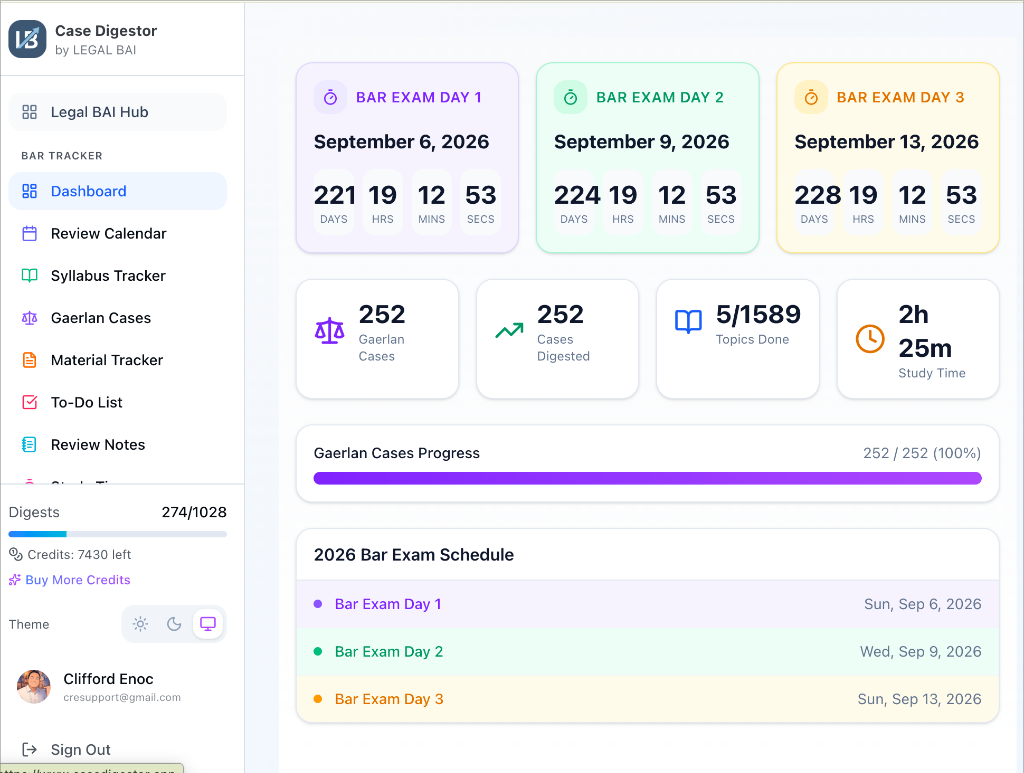
Designed specifically for the 2026 Bar, the toolkit integrates 6 Must-Have Tools into a single cohesive dashboard:
- Case Library: AI-powered analysis of Supreme Court decisions with strict legal formatting.
- Mock Bar Exam: Practice with AI-generated questions tailored to recent jurisprudence and codal provisions.
- 2026 Bar Syllabus: A fully interactive map of the 6 core bar subjects.
- Review Tracker: Visual progress tracking to ensure no topic is left behind.
- Bar Q&A: Comprehensive reviewer aligned with the latest syllabus.
- Legal Research Assistant: Semantic search across 30,000+ PH jurisprudence cases.
The toolkit reduces review fatigue by combining planning, practice, and jurisprudence analysis in one workflow.
Credit-Sensitive vs Planning Features
Not every toolkit interaction has the same economy behavior. Use this quick guide:
| Toolkit surface | Typical behavior |
|---|---|
| Syllabus tracking, notes, and planning flows | Usually planning-first; commonly non-billable actions |
| Mock Bar sessions and question generation | Credit-sensitive and access-gated by current eligibility |
| AI case digestion and related AI generation | Usually credit-sensitive |
| AI chat support inside review workflow | May be both credit-aware and quota-limited |
| Reviewing already saved material | Usually non-billable |
Actual cost/access values depend on your current plan and runtime configuration. For canonical user guidance, see Resource Management.
The Bar Tracker
Efficiency in bar review requires a clear understanding of your strengths and weaknesses. The toolkit provides a visual dashboard that mirrors the hierarchical structure of the Bar Syllabus.
Visual Progress Dashboard
The Dashboard gives you a macro-view of your preparedness, showing:
- Countdown Timers: Days remaining until each Bar Exam Sunday.
- Study Metrics: Total cases digested, topics completed, and study hours logged.
- Overall Progress: A consolidated view of your completion rate across all subjects.
Syllabus Heat-Mapping
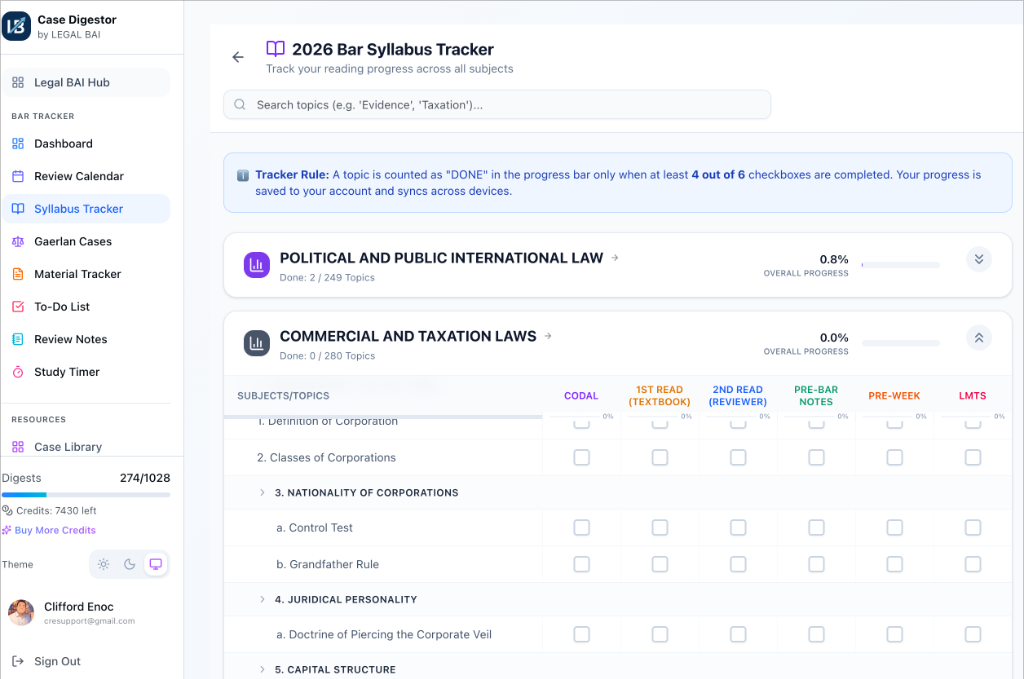 Navigate the Syllabus Tracker to mark individual topics as "Not Started," "Started," or "Done." The system aggregates this data to visualize which areas (e.g., Remedial Law vs. Taxation) require more attention, ensuring no topic is left behind.
Mock Bar & Q&A Integration
Preparation is incomplete without practice. The toolkit integrates testing directly into your study workflow.
Simulated Bar Exams
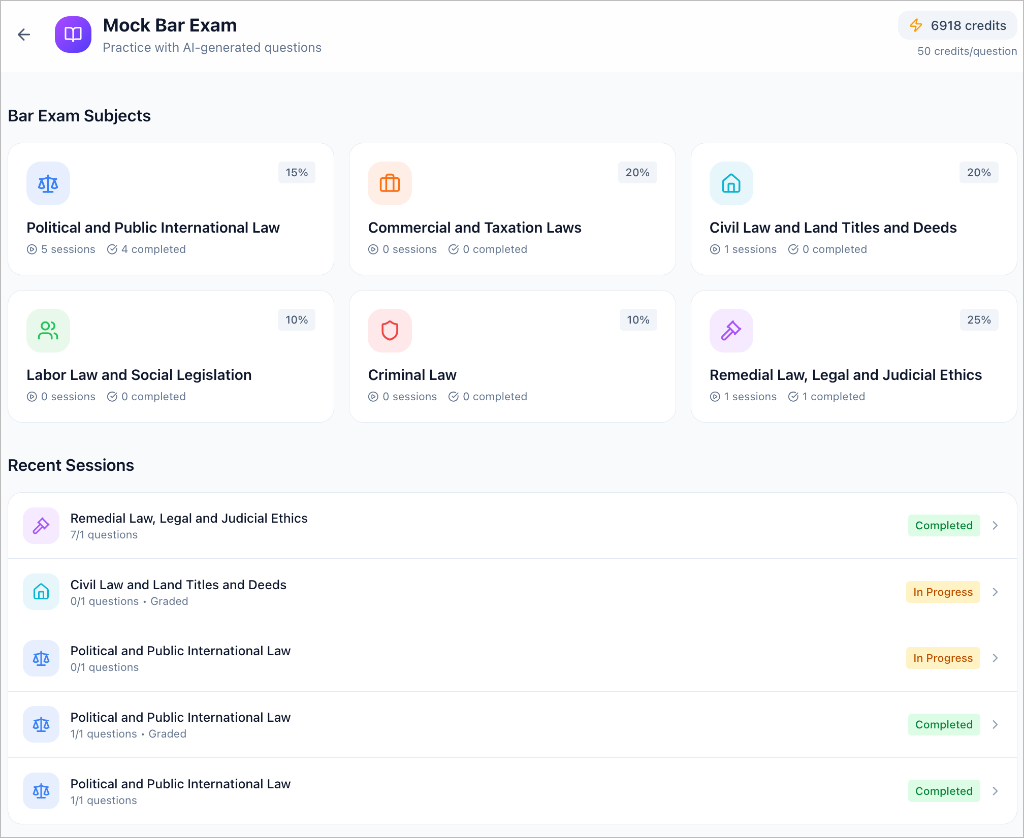 The Mock Bar module allows you to take AI-generated practice exams tailored to specific subjects or mixed sets. Track scores over time to identify weak areas and trendlines.
In practice, this is one of the most credit-sensitive toolkit surfaces. Before launching heavy sessions, check your current balance and minimum-eligibility prompts in-app.
Contextual Q&A
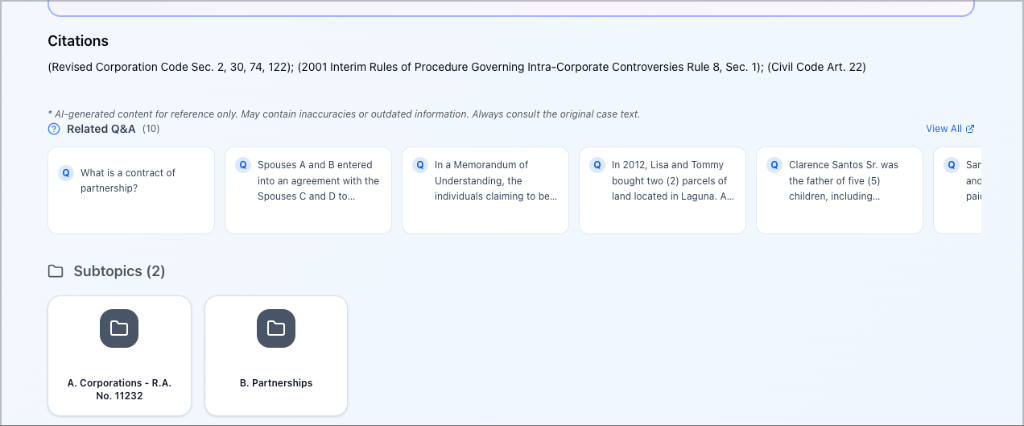 When studying a specific doctrine—such as "Double Jeopardy"—the system surfaces Related Q&A cards. These show how the doctrine has been tested in previous exams or hypothetical scenarios, allowing you to test your application skills immediately.
Exam-Oriented Digestion: When generating digests in the toolkit, the AI prioritizes "Bar Highlights"—key takeaways that are frequently the subject of examiners' questions, such as "requisites," "exceptions," and "landmark distinctions."
Organization and Mastery Integration
Success in the Bar is as much about organization as it is about legal knowledge. The toolkit allows for a highly structured study environment:
- Jurisdiction and Subject Filtering: Quickly sort your saved digests and notes by Bar subject or jurisdiction to align with your weekly study schedule (e.g., "Labor Law Week").
- Doctrinal Mastery Cards: The system can generate "Mastery Cards" for saved cases, distilling the most examinable points into a flashcard-like format for quick review sessions.
- Syllabus Navigation: Instead of navigating by date or G.R. number, the toolkit encourages navigation via the Syllabus Path. This ensures that every case you read is mentally filed under its proper legal heading, reinforcing the structural knowledge required for the essay portion of the exam.
Study Routine Best Practices
To maximize the benefits of the toolkit, we recommend integrating it into your routine as follows:
- Start with the Tracker: Each study session should begin with the Bar Tracker to identify the day's objective. Set a "Mastery Goal" for a specific sub-topic (e.g., "Master all cases under Original Jurisdiction of the SC").
- Combine Reading with Practice: After reviewing an AI-generated digest for a landmark case, immediately open the related Mock Bar Q&A to see how that case was used in previous exams.
- Active Annotation: Use the personal note feature to write your own "one-liner" for each case. This forced distillation is the most effective way to ensure long-term retention.
- Weekly Mastery Scans: At the end of each week, review completed areas and reroute effort to low-confidence/high-yield topics.
- Budget your AI actions: Use planning and review surfaces first, then trigger billable AI actions where they add the most value.
Use the "Compare" feature to look at cases with conflicting rulings or those that modified earlier doctrines. These "clash points" are high-yield targets for Bar Exam questions.